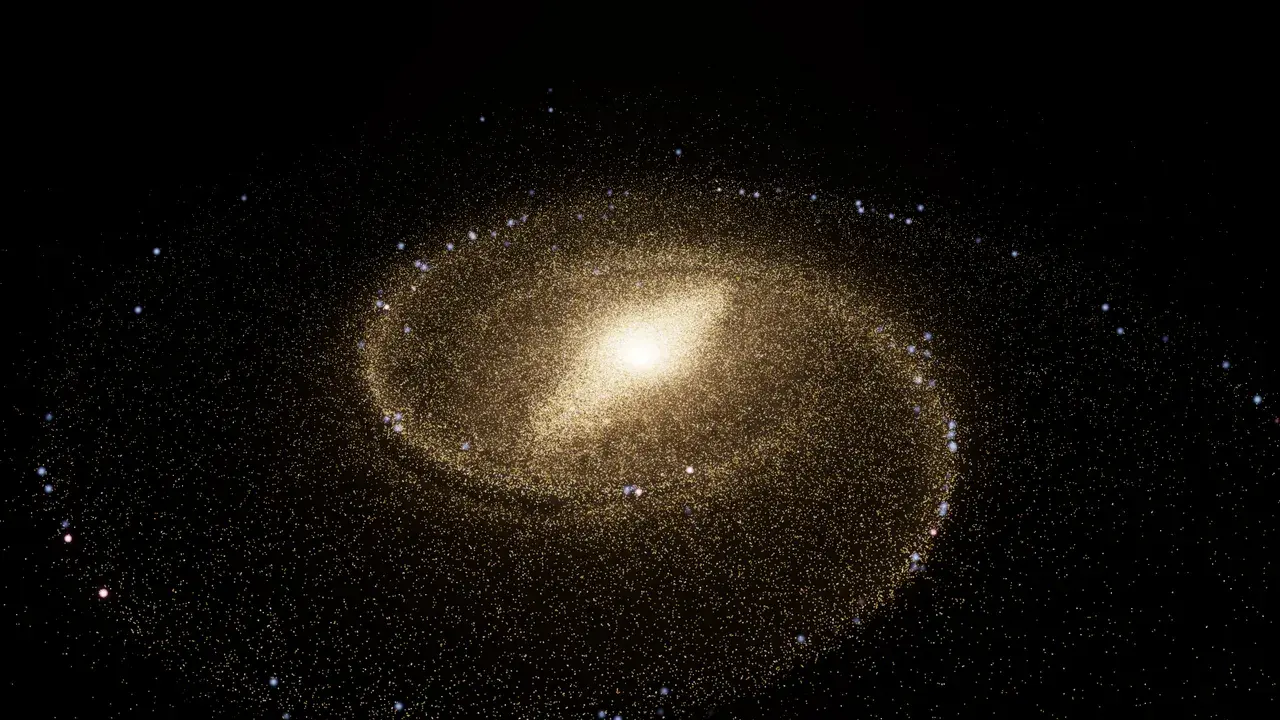
Build a spiral galaxy that works: set its arms, its bar, its bulge and its dark matter, then watch its stars orbit through arms that are waves, not things.
Every star follows its own orbit, at the speed the galaxy’s mass sets: the central bulge, the disc of stars and an unseen halo of dark matter. The spiral arms are density waves, places where the orbits crowd together. Inside corotation, the pattern turns more slowly than the stars passing through it, like a traffic jam that drifts along more slowly than the traffic.
Four real galaxies are presets, each set from published measurements: the Milky Way, the barred spiral NGC 1300, the Sombrero (M104) and the Triangulum (M33). Each comes with its measured rotation curve, so you can see how well the model fits, and what happens to the fit when you change it. NGC 1300’s curve was measured inside its bar, so it only roughly traces circular speed.
Controls
- Drag
- Orbit the camera
- Scroll / pinch
- Zoom
- Presets (left)
- Load a real galaxy and fly to it
- Knobs (right)
- Arms, pitch, bar, bulge, disc, dark matter, star formation; density or material arms
- Time (bottom left)
- Pause, or run at 1, 10 or 50 million years a second
- Phones
- Galaxy, Knobs and Curve tabs at the bottom
Go deeper: Why one edge of an arm is blue ▾
Gas crowding into an arm forms stars, and the most massive of them are hot, blue and short-lived: they burn out within about ten million years, before they have drifted far from the arm that made them. Dark lanes of dust mark the edge where the gas enters an arm and is compressed; the young blue stars and glowing pink clouds of hydrogen lie just past the lanes, and the stars drift on across the arm as they age.
Inside corotation, the radius where the stars keep pace with the pattern, the gas and stars overtake the arms, so they enter each arm at its inner edge, where the dust lanes lie. Beyond corotation the pattern overtakes them and the sides swap. The model keeps that order but spreads it out: it draws its dust just upstream of the crest where its orbits crowd, and lights its young stars at the crest and for ten million years downstream of it, so in the model the blue edge is the outer one inside corotation.
Go deeper: The winding problem ▾
Stars near the centre go round faster than stars far out. If the arms were made of the same stars for good, the inner part would lap the outer part and wind the arms tight within a few turns. Switch the arms to Material and watch it happen. Real spirals are not wound that tight, which is why astronomers concluded that arms are patterns the stars pass through: density waves (C. C. Lin and Frank Shu, 1964).
Go deeper: Rotation curves and dark matter ▾
If a galaxy were only its stars and gas, its outer stars would orbit more and more slowly with distance, as the outer planets do around the Sun. When Vera Rubin, Kent Ford and their colleagues measured the rotation of spiral galaxies, the curves stayed flat far out (Rubin, Ford and Thonnard, 1980). Something unseen holds those stars in, and the leading explanation is a halo of dark matter. Turn the halo down and watch the outskirts slow and shear. In the Triangulum preset the measured curve reaches far past the stars: its gas keeps circling out to 23 kpc, and dark matter dominates outside about 7 kpc (Corbelli et al., 2014).
Go deeper: Supernovae and the arms ▾
Stars many times the Sun’s mass burn through their fuel in about ten million years or less (Ekström et al., 2012), and they end as supernovae, so a supernova of that kind goes off soon after, and not far from, where its star formed. Aramyan and colleagues (2016) measured where 215 supernovae lie across the arms of their host galaxies: the core-collapse ones sit at a set place across the arm, in grand-design spirals, nearer the edge where the gas enters and stars form (the inner edge inside corotation, the outer edge beyond it), and near the arm’s peak in the rest, as short-lived stars formed in the arms would, while Type Ia supernovae, whose stars are older and less massive, are spread more widely around them.
The Milky Way has about 1.6 core-collapse supernovae a century (Rozwadowska, Vissani and Cappellaro, 2021). In the model a flash marks one: a young star ending its life about ten million years after it crossed an arm. So the model’s flashes come on the far side of its crest, further from where the gas enters than the measured ones. The model also flashes Type Ia supernovae, scattered over the old stars rather than tied to the arms: roughly one a second at ten million years a second on a desktop screen, which at the Milky Way preset is about a quarter as many as the core-collapse flashes, the ratio Li et al. (2011) give for a galaxy like ours. The screen shows far fewer than the real galaxy would: at the Milky Way preset on a desktop screen, each flash stands for about 44,000 real supernovae, and for about 160,000 on a phone or tablet (or any window 640 px wide or narrower), which draws a quarter of the stars. Other settings of the knobs, and the other galaxies, change the number.
Go deeper: The bulge ▾
The crowd of stars at the centre of the Milky Way is called the bulge, and it is bar-shaped, about 13,000 light years long. A supermassive black hole sits at the middle, about four million times the mass of the Sun.
Sources & credits
- ApJ 543, 704 · Debattista, V. P. & Sellwood, J. A. 2000 · Cited (paper)
- ApJ 586, 143 · Kranz, T., Slyz, A. & Rix, H.-W. 2003 · Cited (paper)
- A&A 537, A146, Tables 2 and 3 · Ekström, S. et al. 2012 · Cited (paper)
- A&A 436, 1049, Table 1 · Martins, F., Schaerer, D. & Hillier, D. J. 2005 · Cited (paper)
- MNRAS 498, 235 · Haydon, D. T. et al. 2020 · Cited (paper)
- JRASC 95, 32, "The Real Starry Sky", Table 2 · LeDrew, G. 2001 · Cited (paper)
- "What color are the stars?" · Charity, M. 2001 (updated 2016) · Cited (web page)
- ESO Picture of the Week potw2003a, "Caught 'Pink-Handed'", 20 January 2020 · ESO · Cited (web page)
- "The Color of Nebulae and Interstellar Dust in the Night Sky" (updated 2025) · Clark, R. N. 2015 · Cited (web page)
- A&A 641, A6, Table 2 · Planck Collaboration 2020 · Cited (paper)
- ApJ 140, 646, "On the Spiral Structure of Disk Galaxies" · Lin, C. C. & Shu, F. H. 1964 · Cited (paper)
- ApJ 238, 471, "Rotational properties of 21 Sc galaxies with a large range of luminosities and radii, from NGC 4605 (R = 4 kpc) to UGC 2885 (R = 122 kpc)" · Rubin, V. C., Ford, W. K. Jr. & Thonnard, N. 1980 · Cited (paper)
- ApJ 356, 359, "An analytical model for spherical galaxies and bulges" · Hernquist, L. 1990 · Cited (paper)
- ApJ 160, 811, "On the Disks of Spiral and S0 Galaxies" · Freeman, K. C. 1970 · Cited (paper)
- A&A 625, L10 · GRAVITY Collaboration (Abuter, R. et al.) 2019 · Cited (paper)
- ARA&A 54, 529 · Bland-Hawthorn, J. & Gerhard, O. 2016 · Cited (paper)
- ApJ 871, 120, Table 1 · Eilers, A.-C., Hogg, D. W., Rix, H.-W. & Ness, M. K. 2019 · Cited (paper)
- PASP 121, 213, "The Spitzer/GLIMPSE Surveys: A New View of the Milky Way" · Churchwell, E. et al. 2009 · Cited (paper)
- MNRAS 450, 4277 · Vallée, J. P. 2015 · Cited (paper)
- ApJ 574, 740, Appendix A · Tremaine, S. et al. 2002 · Cited (paper)
- ApJ 806, 96 · Licquia, T. C. & Newman, J. A. 2015 · Cited (paper)
- MNRAS 465, 1621 · Portail, M., Gerhard, O., Wegg, C. & Ness, M. 2017 · Cited (paper)
- RC3, VizieR VII/155 · de Vaucouleurs et al. 1991 · Cited (catalogue)
- MNRAS 501, 3621 · Anand, G. S. et al. 2021 · Cited (paper)
- ApJ 897, 122, Table D1 · Lang, P. et al. 2020 · Cited (paper)
- MNRAS 403, 83 · Kalapotharakos, C., Patsis, P. A. & Grosbøl, P. 2010 · Cited (paper)
- A&A 631, A94 · Díaz-García, S. et al. 2019 · Cited (paper)
- A&A 582, A86 · Herrera-Endoqui, M. et al. 2015 · Cited (paper)
- ApJS 219, 4 (S⁴G P4) · Salo, H. et al. 2015 · Cited (paper)
- ApJS 244, 24 (z0MGS) · Leroy, A. K. et al. 2019 · Cited (paper)
- AJ 152, 144, "The Distance to M104" · McQuinn, K. B. W. et al. 2016 · Cited (paper)
- ApJ 220, 98 · Schweizer, F. 1978 · Cited (paper)
- ApJ 739, 21 · Jardel, J. R. et al. 2011 · Cited (paper)
- ApJ 289, 81, Table 4 · Rubin, V. C. et al. 1985 · Cited (paper)
- ApJ 338, 752 · Kormendy, J. & Westpfahl, D. J. 1989 · Cited (paper)
- ApJ 773, 69 · Gieren, W. et al. 2013 · Cited (paper)
- AJ 154, 41, Table 1 · Kam, S. Z. et al. 2017 · Cited (paper)
- MNRAS 464, 2103 · Javadi, A. et al. 2017 · Cited (paper)
- A&A 572, A23, Table 1 · Corbelli, E., Thilker, D., Zibetti, S., Giovanardi, C. & Salucci, P. 2014 · Cited (paper)
- A&A 493, 453 · Verley, S., Corbelli, E., Giovanardi, C. & Hunt, L. K. 2009 · Cited (paper)
- MNRAS 450, 4050, "The structure of the Milky Way's bar outside the bulge", Table 1 · Wegg, C., Gerhard, O. & Portail, M. 2015 · Cited (paper)
- ApJ 645, 134, "Spitzer and JCMT Observations of the Active Galactic Nucleus in the Sombrero Galaxy (NGC 4594)", Table 3 · Bendo, G. J. et al. 2006 · Cited (paper)
- New Astronomy 83, 101498, abstract and §4 · Rozwadowska, K., Vissani, F. & Cappellaro, E. 2021 · Cited (paper)
- MNRAS, "Supernovae and their host galaxies - IV. The distribution of supernovae relative to spiral arms", abstract and §5 · Aramyan, L. S. et al. 2016 · Cited (paper)
- MNRAS 412, 1473, "Nearby supernova rates from the Lick Observatory Supernova Search III", Table 11 · Li, W. et al. 2011 · Cited (paper)
- ESA/Hubble opo0501a, "A poster-size image of the beautiful barred spiral galaxy NGC 1300" · NASA, ESA, and The Hubble Heritage Team (STScI/AURA) · CC BY 4.0 (ESA/Hubble) · Resized from 6637 × 3787 px (the Large JPEG) to 2400 px wide and converted to WebP.
- ESA/Hubble opo0328a, "Hubble mosaic of the majestic Sombrero Galaxy" · NASA/ESA and The Hubble Heritage Team (STScI/AURA) · CC BY 4.0 (ESA/Hubble) · Resized from 11472 × 6429 px (the Large JPEG) to 2400 px wide and converted to WebP.
- ESA/Hubble heic1901a, "The sharpest view ever of the Triangulum Galaxy" · NASA, ESA, and M. Durbin, J. Dalcanton, and B. F. Williams (University of Washington) · CC BY 4.0 (ESA/Hubble) · Resized from 4000 × 2251 px (the Publication JPEG, the full 34372 × 19345 px frame scaled down) to 2400 px wide and converted to WebP.