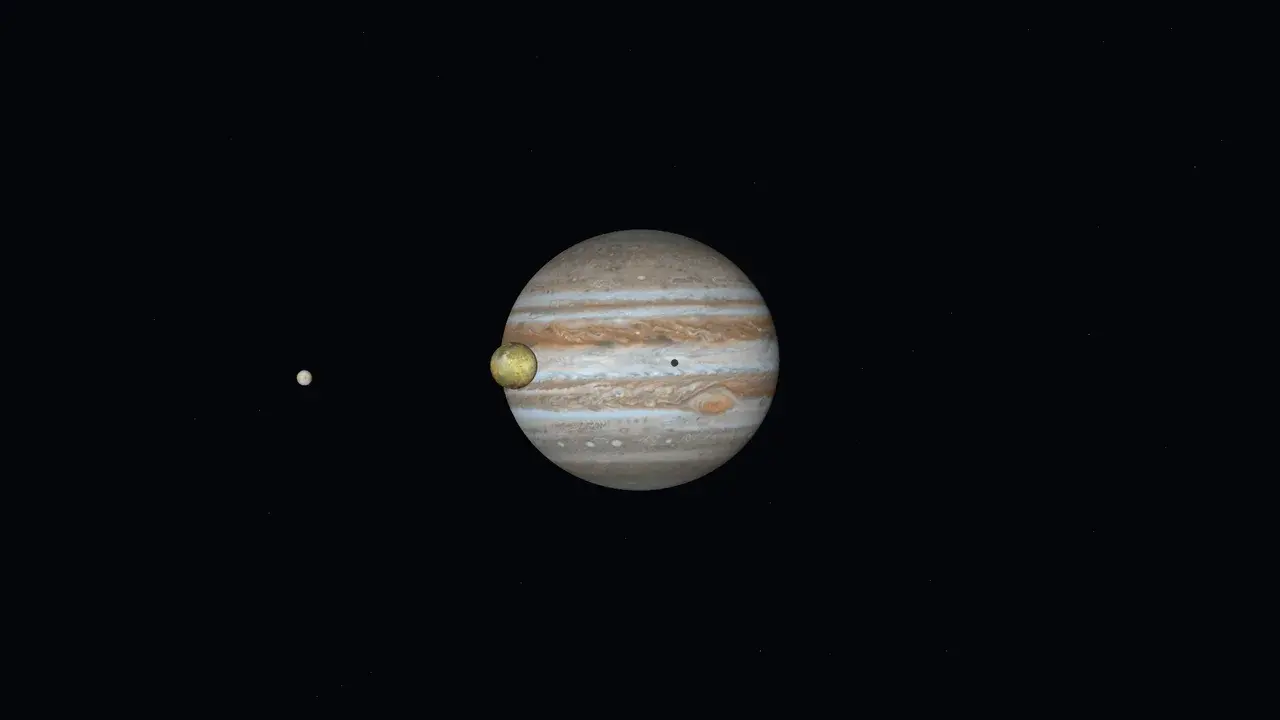
Jupiter’s four big moons where they really are, tonight: step outside with binoculars and check. The page also lists tonight’s transits, shadows and eclipses with their times, worked out from published theories of the moons’ motion and checked against NASA JPL’s ephemeris.
Ordinary binoculars show what Galileo saw in January 1610: Jupiter as a small bright disc with up to four points of light strung out in a line beside it. Rest them on a wall or a fence post to hold them steady. From night to night, and even hour to hour, the moons change places.
The From Earth view draws them as your binoculars or telescope show them. Choose your hemisphere: from south of the equator the sky’s north is down. A simple telescope turns the view upside down and a star diagonal mirrors it, so choose the one you are using; with your location, the view can also turn to match your sky.
A small telescope adds the moons’ shadows: when a moon passes in front of Jupiter, its shadow falls on the cloud tops as a sharp black dot. The list under Tonight gives each crossing, each shadow and each time a moon slips behind Jupiter or into its shadow.
Controls
- 3D / From Earth
- Switch between the moons in space and as seen from Earth
- Now, ± buttons
- Show now, or step the time by 10 minutes, an hour or a day
- ← / →
- Step 10 minutes (with the time bar focused)
- Next event
- Jump to just before the next moon event
- Drag, scroll / pinch
- Turn and zoom the 3D view; zoom the eyepiece
- ⚙ (3D, top right)
- Moons, labels, orbits, sound and info
Go deeper: Where the moons were, not where they are ▾
Light takes 33 to 54 minutes to reach us from Jupiter, depending on where Earth and Jupiter are in their orbits. Both views show each moon where it was when its light set out, which is what your eyes receive, so a shadow crosses Jupiter in 3D just when the list says you will see it.
That delay is how light’s speed was first shown to be finite. In 1676 Ole Rømer noticed that Io’s eclipses came later than expected while Earth was moving away from Jupiter and earlier as it came closer, and explained it by the time light takes to cross the extra distance.
Go deeper: The moons’ rhythm ▾
Io, Europa and Ganymede move in a 1:2:4 rhythm: for each orbit of Ganymede, Europa makes two and Io four. Their regular tugs on one another keep the rhythm going and stretch their orbits slightly, so a simple ellipse is not enough to say where they are.
The farthest each moon strays from Jupiter on the sky is about 5.9 Jupiter radii for Io, 9.5 for Europa, 15.0 for Ganymede and 26.5 for Callisto: up to 11 arcminutes, about a third of the Moon’s width.
Go deeper: How the page works them out ▾
The moons come from Lieske’s E5 theory of the Galilean satellites, as Jean Meeus gives it, and Earth and Jupiter from the VSOP87 planetary theory. Tests hold both against NASA JPL’s Horizons ephemeris: over two months of events, October 2026 and February 2027, every transit, shadow, occultation and eclipse matched, and the times agreed to within two minutes. Further from today the theory’s error grows, so treat the times as good to a few minutes for dates decades away.
Go deeper: The Galilean moons ▾
Io (3,643 km): The most volcanically active body in the solar system, with over 400 active volcanoes.
Europa (3,122 km): Covered in a smooth ice shell that likely hides a vast subsurface ocean — a prime candidate for extraterrestrial life.
Ganymede (5,268 km): The largest moon in the solar system — bigger than Mercury — and the only moon known to have its own magnetic field.
Callisto (4,821 km): The most heavily cratered object in the solar system, with a surface that may be over 4 billion years old.
Sources & credits
- Jupiter colour map (Cassini composite, retouched) · Planet Pixel Emporium (James Hastings-Trew) · Copyright James Hastings-Trew. Free to use in renderings and real-time software; the maps may not be redistributed as is (Planet Pixel Emporium terms)
- Astronomical Algorithms, 2nd ed. (1998): ch. 44, the Galilean satellites (Lieske’s theory E5), and the sidereal time, precession and rise and set methods · J. Meeus · Cited (book)
- astronomia (jupitermoons.js): the E5 terms, transcribed · Sonia Keys and commenthol · MIT (notice in src/experiences/jupiter/engine/galilean.ts)
- VSOP87B planetary theory (Earth and Jupiter, truncated) · P. Bretagnon and G. Francou (1988), Astron. Astrophys. 202, 309; CDS catalogue VI/81 · Cited (published theory)
- Horizons ephemeris system: the positions and events the tests check against · NASA/JPL Solar System Dynamics · Public domain (NASA/JPL)
- Polynomial expressions for ΔT · F. Espenak and J. Meeus (NASA) · Public domain (NASA)
- Jupiter’s pole and rotation (IAU WGCCRE 2015 report) · B. A. Archinal et al. (2018), Celest. Mech. Dyn. Astron. 130, 22 · Cited (published report)