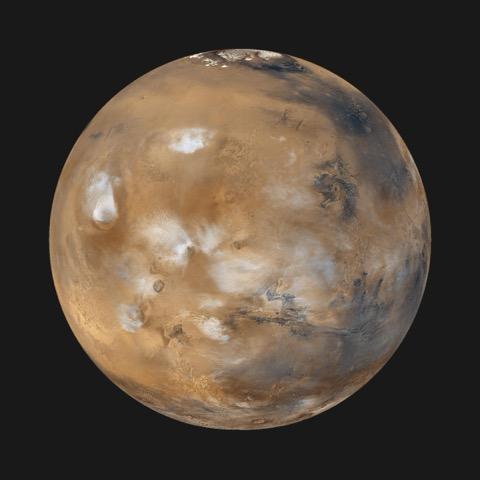
The red planet: a cold desert world with the tallest volcano and one of the largest canyon systems in the Solar System.
Mars is red because its dust is rich in iron oxide. The planet is, in effect, rusty.
Mars turns once in 24 h 37 min, close to Earth’s 23 h 56 min, and it is tilted 25°, so it has seasons too. But its thin carbon-dioxide air holds so little heat that nights often fall below −70 °C.
Controls
- Drag
- Orbit the camera
- Scroll / pinch
- Zoom
- ⚙ (top right)
- Animation, display, sound and info controls
Go deeper: Olympus Mons and Valles Marineris ▾
Olympus Mons is a shield volcano roughly 22 km high, about 25 km above the plains around it, and some 600 km wide. Valles Marineris, a canyon system roughly 4,000 km long and 7 to 9 km deep, would stretch across the United States.
Go deeper: Phobos and Deimos ▾
Mars has two small, lumpy moons. Phobos orbits faster than Mars turns, so from the surface it rises in the west. It is slowly spiralling inward and will break apart or crash within about 50 million years.
Sources & credits
- Mars colour map · Solar System Scope · CC BY 4.0
- Mars bump and normal maps · Planet Pixel Emporium (James Hastings-Trew) · Copyright James Hastings-Trew. Free to use in renderings and real-time software; the maps may not be redistributed as is (Planet Pixel Emporium terms)