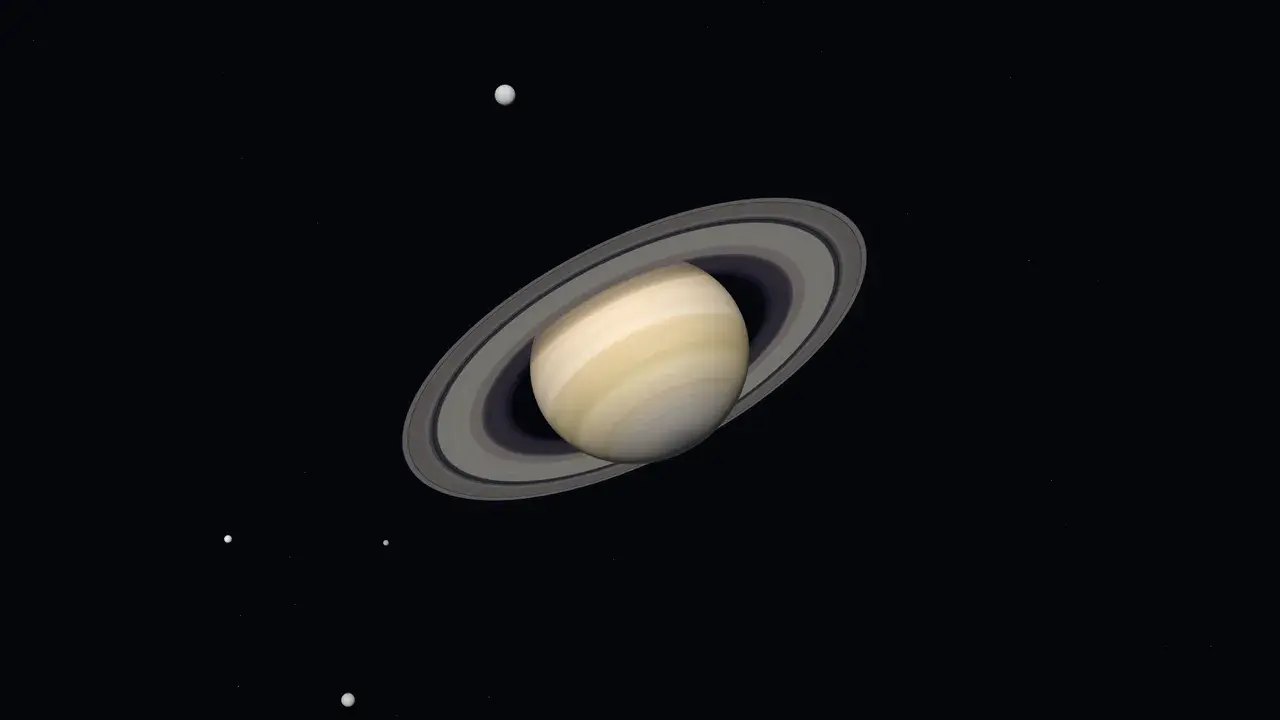
Saturn’s rings and eight of its moons where they really are, tonight: a small telescope shows the rings and Titan where the page draws them. The page also lists the moons’ transits, shadows and eclipses with their times, worked out from published theories and checked against NASA JPL’s ephemeris.
Any small telescope shows Saturn’s rings, 34″ to 47″ across depending on where Earth and Saturn are, and Titan, the biggest moon, as a point of light up to 3.6 arcminutes from the planet. Rhea, Dione and Tethys are fainter and want a darker sky; Iapetus is brighter on one side of its orbit than the other. Enceladus, Mimas and Hyperion are hard to see in a small telescope, and the page labels them so.
The From Earth view draws Saturn as your telescope shows it. Choose your hemisphere: from south of the equator the sky’s north is down. A simple telescope turns the view upside down and a star diagonal mirrors it, so choose the one you are using; with your location, the view can also turn to match your sky.
Saturn’s axis is tilted 26.7°, so over its 29½-year orbit we see the rings from below, edge-on and from above. They were edge-on to us in March 2025, open to about 27° in 2032, and close to edge-on again in 2038 and 2039. The page says how far they are tilted tonight, and which face we see.
Controls
- 3D / From Earth
- Switch between the moons in space and as seen from Earth
- Now, ± buttons
- Show now, or step the time by 10 minutes, an hour or a day
- ← / →
- Step 10 minutes (with the time bar focused)
- Next event
- Jump to just before the next moon event
- Drag, scroll / pinch
- Turn and zoom the 3D view; zoom the eyepiece
- ⚙ (3D, top right)
- Moons, labels, orbits, sound and info
Go deeper: Why the list is often empty ▾
A moon crosses Saturn’s globe, or its shadow does, only when we see the rings nearly edge-on, because these moons orbit close to the rings’ plane: Tethys, the innermost moon listed, while they are tilted less than about 12°, Titan less than about 3°. So the list is busy until the middle of 2027, empty from then until late 2036 (on most nights the page says why), and busy again through the edge-on years of 2038 and 2039.
Go deeper: Where the moons were, not where they are ▾
Light takes 67 to 92 minutes to reach us from Saturn. Both views show each moon where it was when its light set out, which is what your eyes receive, so a shadow crosses Saturn in 3D just when the list says you will see it.
Go deeper: How the page works them out ▾
The moons come from the theories of Harper and Taylor and of Taylor, as Jean Meeus gives them, and Earth and Saturn from the VSOP87 planetary theory. Tests hold both against NASA JPL’s Horizons ephemeris. Over three months of events every transit, shadow, occultation and eclipse matched; Tethys’s, Dione’s and Rhea’s times agreed to within two and a half minutes and Titan’s to within eight, so Titan’s are given as “about”. Iapetus’s were about half an hour out, so the page draws Iapetus but does not list its events.
On the sky the moons are placed to within a twentieth of Saturn’s radius, except Iapetus, to within about a tenth, and Hyperion, whose orbit the theory follows least well, to within about half.
Go deeper: The moons ▾
Titan (5,149 km), bigger than Mercury, is the only moon with a thick atmosphere; its lakes and seas are liquid methane and ethane.
Rhea (1,528 km), Iapetus (1,469 km), Dione (1,123 km) and Tethys (1,062 km) are icy moons. One face of Iapetus is dark and the other bright, so it looks brighter on one side of Saturn than the other.
Enceladus (504 km) sprays water from an ocean beneath its ice; Mimas (396 km) carries a crater a third of its own width; Hyperion (270 km) is a tumbling, sponge-like body of ice.
Go deeper: How long is a day? ▾
Saturn has no solid surface to watch, so its day was hard to pin down. In 2019, waves that Saturn’s interior raises in its rings, measured by the Cassini spacecraft, gave 10 hours 33 minutes 38 seconds; the 3D view turns at that rate.
Sources & credits
- Saturn colour map · Solar System Scope · CC BY 4.0
- Saturn ring map · Solar System Scope · CC BY 4.0 · Reprojected from the 8K strip into a top-down picture with the rings at NASA’s radii, and brightened (tools/textures/ring_from_strip.py)
- Astronomical Algorithms, 2nd ed. (1998): ch. 46, the satellites of Saturn (Harper and Taylor’s and Taylor’s theories), and the precession, sidereal time and rise and set methods · J. Meeus · Cited (book)
- astronomia (saturnmoons.js): the chapter 46 terms, transcribed · Sonia Keys and commenthol · MIT (notice in src/experiences/saturn/engine/saturnian.ts)
- VSOP87B planetary theory (Earth and Saturn, truncated) · P. Bretagnon and G. Francou (1988), Astron. Astrophys. 202, 309; CDS catalogue VI/81 · Cited (published theory)
- Horizons ephemeris system: the positions and events the tests check against · NASA/JPL Solar System Dynamics · Public domain (NASA/JPL)
- Polynomial expressions for ΔT · F. Espenak and J. Meeus (NASA) · Public domain (NASA)
- Saturn’s pole (IAU WGCCRE 2015 report) · B. A. Archinal et al. (2018), Celest. Mech. Dyn. Astron. 130, 22 · Cited (published report)
- Saturn’s rotation period from ring seismology · C. Mankovich et al. (2019), ApJ 871, 1 · Cited (published paper)
- Saturn Fact Sheet, Saturnian Rings Fact Sheet and Saturnian Satellite Fact Sheet: the radii and the rings · NASA Goddard Space Flight Center (NSSDCA) · Public domain (NASA)