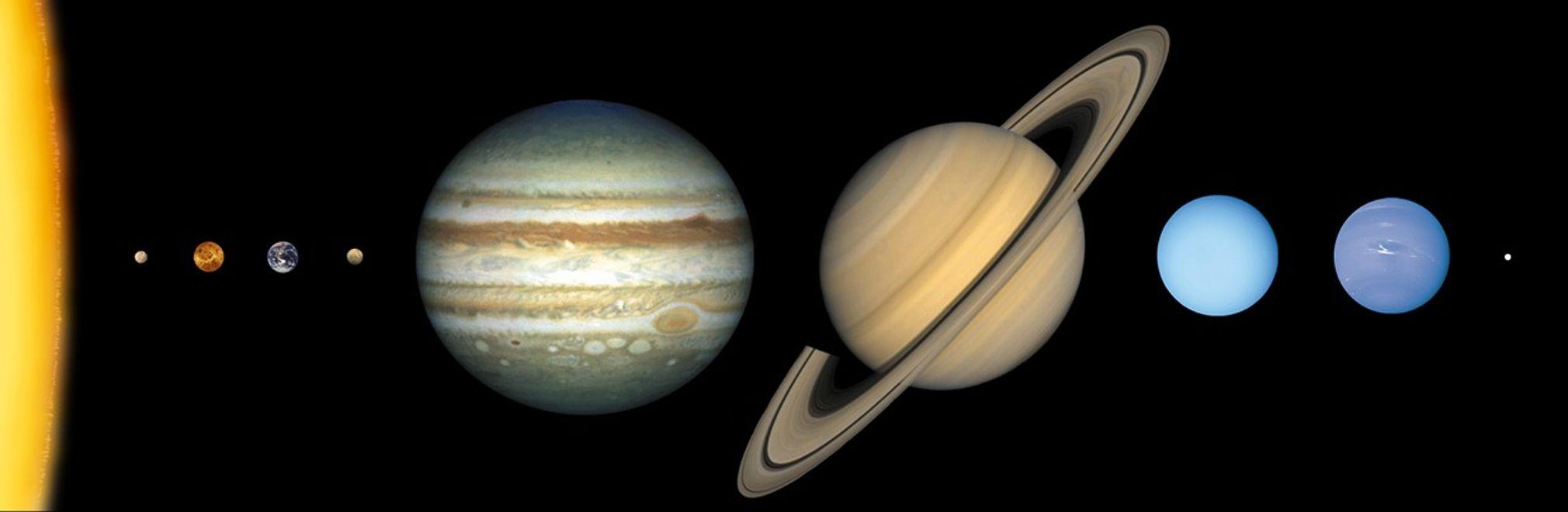
The Sun and its eight planets, on orbits of their real size and shape, at a speed you control.
The planets follow orbits of their real size, shape and period, all in the same direction. The bodies themselves are enlarged, because at true scale every planet would be smaller than a pixel.
At 1×, one second of real time is one hour of simulated time, so Mercury takes about 35 minutes to go once round the Sun and Neptune about 17 days. Click a planet to fly to it; zoom in first to reach the small inner planets.
Controls
- Click a planet
- Fly to it (zoom in first to reach the small inner planets)
- Drag
- Orbit the camera
- Scroll / pinch
- Zoom
- ⚙ (top right)
- Time scale and display controls
Go deeper: Scale ▾
The Sun is 1.39 million km across, 109 times wider than Earth, and holds 99.8% of the Solar System’s mass. Sunlight takes about 8 minutes 20 seconds to reach us.
Go deeper: The odd spinners ▾
Venus spins backwards, and so slowly that its day (243 Earth days) is longer than its year (225). Uranus is tipped 98° over and rolls around the Sun on its side.
Sources & credits
- Planet, Moon and Saturn maps · Solar System Scope · CC BY 4.0
- Saturn ring map · Solar System Scope · CC BY 4.0 · Reprojected from the 8K strip into a top-down picture with the rings at NASA’s radii, and brightened (tools/textures/ring_from_strip.py)
- Earth bump and specular maps, Jupiter colour map · Planet Pixel Emporium (James Hastings-Trew) · Copyright James Hastings-Trew. Free to use in renderings and real-time software; the maps may not be redistributed as is (Planet Pixel Emporium terms)
- 8 Low Poly Asteroids · Everios96 (Sketchfab) · CC BY 4.0